


Most of us inherited our relationship with money before we ever earned a dollar of it, then spent decades chasing, rebelling against, or hiding from a story that was never really about money at all.
This is a guide to noticing that story, and learning how to put it down.
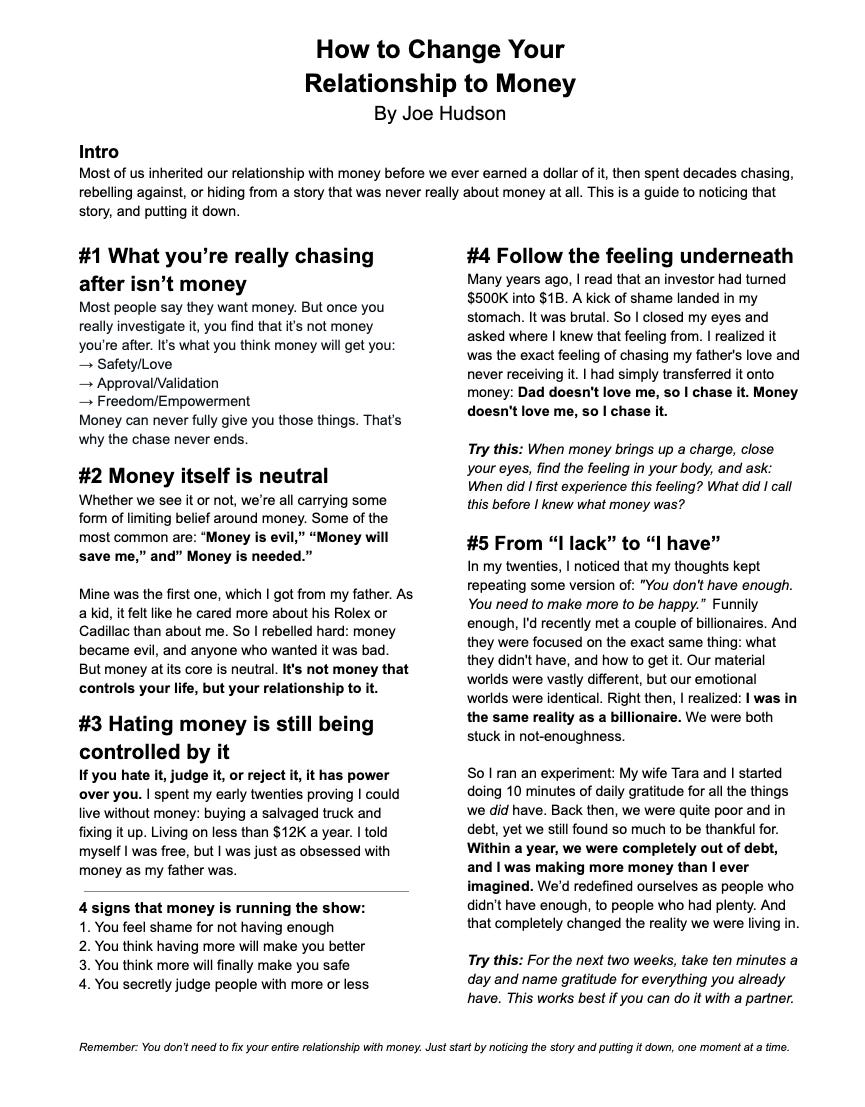
#1 What you’re really chasing after isn’t money
Most people say they want money. But once you really investigate that desire, you find that it’s not money you’re after. It’s what you think money will get you:
→ Safety/Love
→ Approval/Validation
→ Freedom/Empowerment
Money can never fully give you those things. That’s why the chase never ends.
#2 Money itself is neutral
Whether we see it or not, we’re all carrying some form of limiting belief around money. Some of the most common are:
“Money is evil”
“Money will save me”
”Money is needed.”
Mine was the first one, which I got from my father. As a kid, it felt like he cared more about his Rolex or Cadillac than about me. So I rebelled hard: money became evil, and anyone who wanted it was bad.
But money at its core is neutral.
It’s not money that controls your life, but your relationship to it.
#3 Hating money is still being controlled by it
I spent my early twenties proving I could live without money: buying a salvaged truck and fixing it up. Living on less than $12K a year. I told myself I was free, but I was just as obsessed with money as my father was.
If you hate it, judge it, or reject it, it has power over you.
4 signs that money is running the show:
1. You feel shame for not having enough
2. You think having more will make you better
3. You think more will finally make you safe
4. You secretly judge people with more or less
#4 Follow the feeling underneath
Many years ago, I read that an investor had turned $500K into $1B. A kick of shame landed in my stomach. It was brutal. So I closed my eyes and asked where I knew that feeling from. I realized it was the exact feeling of chasing my father’s love and never receiving it. I had simply transferred it onto money: Dad doesn’t love me, so I chase it. Money doesn’t love me, so I chase it.
Try this: When money brings up a charge, close your eyes, find the feeling in your body, and ask: When did I first experience this feeling? What did I call this before I knew what money was?
#5 From “I lack” to “I have”
In my twenties, I noticed that my thoughts kept repeating some version of: “You don’t have enough. You need to make more to be happy.” Funnily enough, I’d recently met a couple of billionaires. And they were focused on the exact same thing: what they didn’t have, and how to get it. Our material worlds were vastly different, but our emotional worlds were identical. Right then, I realized: I was in the same reality as a billionaire. We were both stuck in not-enoughness.
So I ran an experiment: My wife Tara and I started doing 10 minutes of daily gratitude for all the things we did have. Back then, we were quite poor and in debt, yet we still found so much to be thankful for. Within a year, we were completely out of debt, and I was making more money than I ever imagined. We’d redefined ourselves as people who didn’t have enough, to people who had plenty. And that completely changed the reality we were living in.
Try this: For the next two weeks, take ten minutes a day and name gratitude for everything you already have. This works best if you can do it with a partner.
Remember: You don’t need to fix your entire relationship with money. Just start by noticing the story and putting it down, one moment at a time.
Download the full one-pager here:
Big Love,
Joe
How did ‘gratitude’ make you think you had plenty and turn that into even more? My first instinct, if one is self-aware about being “poor and in-debt” would be that an *attempt* at gratitude would be met with sarcastic disregard, because it just sounds like gaslighting! How do you make yourself BELIEVE it? How do you turn that into even more (because, if I *did* believe it, my instinct would be to sit on laurels of whatever job I DID have).
I am currently working on a substack article about my childhood conditioning around money. For years I assumed my money issues were related to all the information I was uncovering via conspiracy rabbit holes, something I’ve been doing since the late 90s. The money system is evil! Is pretty much what I concluded. And while there is certain truth in that, there’s not really a single system that ISN”T corrupted. So I need to either go live in a cave somewhere, un-alive myself, OR start investigating my childhood conditioning and work on integrating all the emotions around it I’ve been resisting, etc.. It only took 55 years, Joe! But I’m doing it and boy the things I’ve been unearthing…