



Intro
Shame is nature’s way of training us to belong. When we act outside our tribe’s norms, shame signals: you’re at risk of being cast out. That mechanism was useful once, but it can get stuck. You’re trapped behind an inner electric fence that may have been installed by a parent, a church, or a culture that no longer applies. This is a guide to understanding what shame is, how to find it, and how to move through it.
#1 What Shame Actually Does
Shame is designed to stagnate, not transform. Imagine a little boy, sitting on the couch with his aunties, and letting out a fart. If his aunties shame him for it, he’ll start holding it in.
This means that shame doesn’t just make you feel bad. It actually stops emotional fluidity. It masks difficult feelings (usually grief, anger, or helplessness) and locks them into place. It’s like a backwater/eddy.
Shame can be useful. It’s a great signal to yourself that you’ve done something you don’t want to do. But if you shame yourself over and over again, that’s when you know you’re in stagnation.
#2 The Inner Electric Fence
Shame works like an electric fence. Once you get shocked often enough, you stop going near it, even when it’s not on anymore. The trouble is, this fence was often built by other people. Most of us have never stopped to ask: is this fence actually mine?
#3 How to Find Shame
1. Check your body. Before the mind can spin a story, the body already knows. There’s a specific feeling: kick in the stomach, subtle contraction, or a sense of shrinking inward.
2. Follow the loops. If your mind keeps returning to the same story (regret, justification, or replaying an event) shame is likely underneath. The mind spins because the emotion underneath hasn’t moved.
3. Look for double-binds. Name a want you keep avoiding. Then ask yourself: Do I want the opposite? If neither option feels okay, it’s a sign that you’re in a shame double-bind.
4. Defensiveness and fights. Every time you are defensive, you are being dominated by shame. Notice the next time you feel the urge to explain, justify, or defend yourself. Pause and ask “Which part of me is feeling ashamed right now?”
5. Pay attention to the voice in your head. It can be subtly shaming you even when you don’t see it. This can sound like:
“I didn’t do enough today.”
“I’m not using my time wisely.”
“I’m behind.”
6. List your bad habits. I once made a list of everything in my life that hadn’t changed in ten years. Every single item had shame around it. You can do this too: Make a list of everything in your life that’s been the same for years: habits, patterns, and areas where you keep saying you’ll do something different. Shame is always behind stuckness.
#4 How to Move Through Shame
You can’t think your way out of shame. Intellectually knowing “What I did isn’t morally bad” doesn’t stop the body from flinching. The shift has to happen emotionally.
Shame erodes rapidly when we stop trying to defend ourselves against it. The simplest way to move through shame is to ask: “What would I have to feel if I couldn’t feel ashamed right now?” and then allow yourself to feel that feeling all the way.
Feeling shame is a sign that you’ve abandoned a part of yourself. You can follow the shame to rediscover and welcome that part.
#5 Shame Heals In Relationship
The fastest way through shame is to be loved for the thing you’re ashamed of. If something is broken in relationship, it’s best healed in relationship.
This is why relational work, like what we do in the Connection Course, is so powerful. You say the thing you’re ashamed of, and the room just looks at you with warmth. When your nervous system gets new data, you begin to realize that the electric fence can come down.
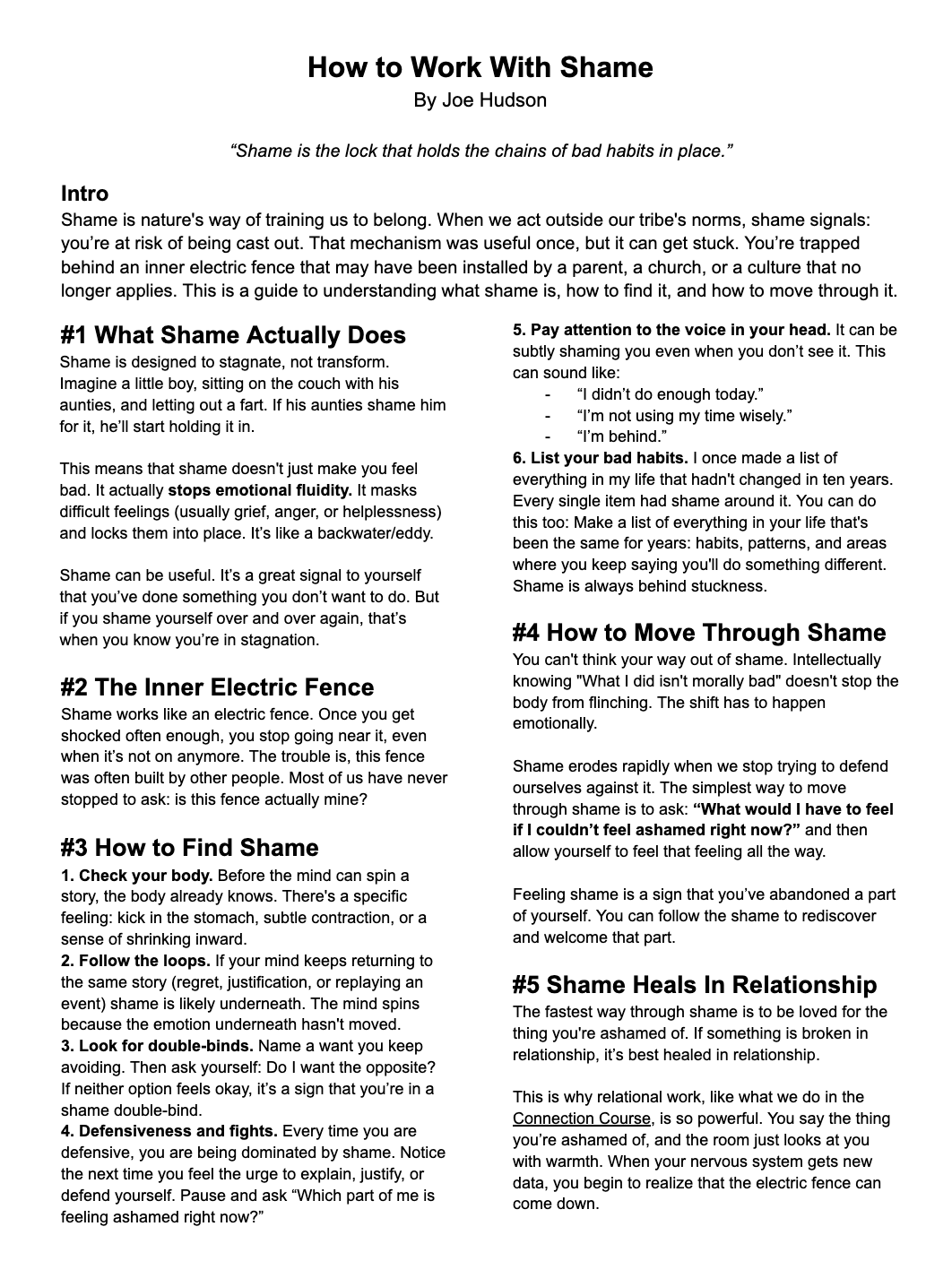
Here’s a full one-pager you can keep handy for reference:
Big Love,
Joe
I’ve spent way too much energy in my life trying to out-think my own discomfort, especially when I feel the urge to explain or justify a decision I’ve made. Learning to just pause and ask myself what feeling I'm trying to run away from has been a game-changer. It turns out the emotion itself is never as heavy as the energy it takes to hide it.
"I view shame as a component of Western civilizational progress. Having good shoes and paid bills means that shame stays buried deep within us, never to remind us of itself again. And many of us, of course, know that neither shoes nor paid bills can guarantee us dignity."